The Sounds Between the Words
How ambient soundscapes turn AI audio into something you want to sit with.
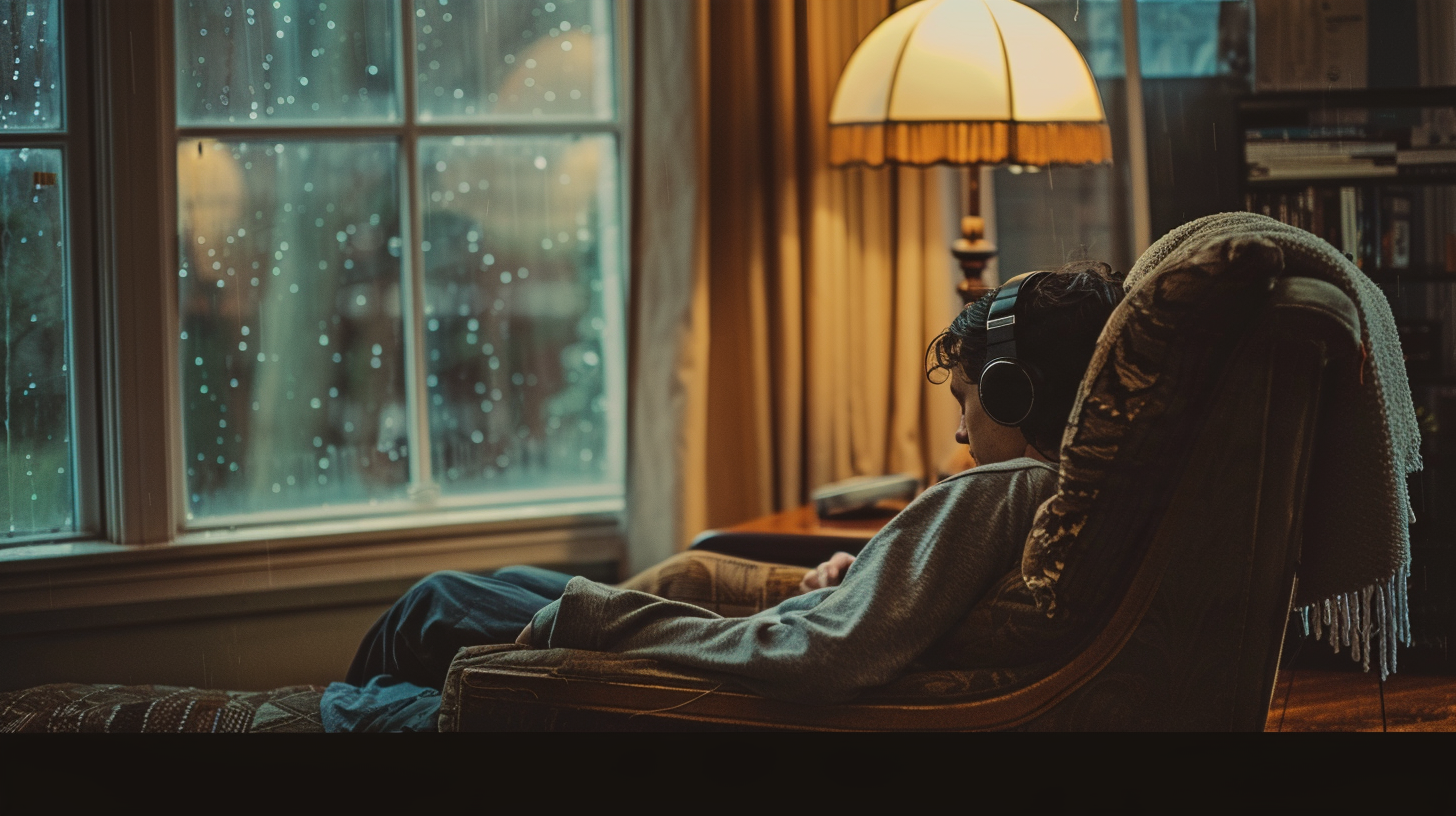
We spent a surprising amount of time getting Parkbench's narrators to stop doing strange things with perfectly ordinary sentences. Words would disappear, vowels would linger long past their welcome, and three little dots on the page could send a text-to-speech model off into the weeds. Once we had most of that under control, listening to a finished meditation was no longer an exercise in spotting faults. But something was still missing.
The narration was clear and unhurried, yet there was very little sense of anything beyond someone reading aloud. Over enough time, even the gentlest voice can begin to feel strangely relentless, especially when every pause opens onto an empty digital silence. We wanted the listener to feel they had arrived somewhere, rather than simply waiting for the next sentence.
So we began experimenting with what happens around the voice, and particularly what happens when it stops speaking. A little rain, the distant hum of a room, music that comes and goes almost without being noticed. Simple enough in principle, although sound has a mischievous habit of drawing attention to itself at precisely the wrong moment. A loop develops a tiny click, a piano note announces itself just as the narrator begins speaking, or a perfectly innocent bed of crickets confuses the software responsible for checking whether the narration is still there.
Making a convincing atmosphere, we discovered, was largely a matter of persuading all these sounds to behave as though nobody had gone to the trouble of putting them there.
Three quarters of the piece
We also began cutting back the amount of narration in our wellness scripts, which naturally brought the overall running time down. But rather than simply making shorter meditations, we wanted to change how that time was spent. We opened up the spaces between passages, allowed longer pauses at section boundaries, and introduced stretches where the music could carry the experience without the narrator feeling obliged to say anything. The result was a little less talking, a little more breathing room, and a rhythm that felt less like being guided through a script and more like being allowed to settle into it.
Some of this thinking grew out of an earlier attempt to make the narration calmer by slowing the voice itself. We had been time-stretching passages that came out faster than the target pace for each narrator, which seemed a reasonable approach until we improved the reference recordings and the voices began speaking more gently on their own. A subsequent listening audit revealed something rather telling: the stretched passages were now the only ones that sounded unnatural. Without the surrounding narration rushing along, the artificial slowing had nowhere to hide. We eventually abandoned time-stretching altogether.
It turned out that we had been looking for calm in the wrong place. Rather than interfering with the natural pace of the voice, we could let the meditation itself unfold more slowly, with longer stretches where nothing needed to be said. Our estimates suggested that narration would now occupy roughly a quarter of a session, compared with closer to forty percent before, even with the shorter overall running time.
Of course, all that breathing room presented another problem. Without something to inhabit those pauses, much of the experience would consist of digital silence. Even a quiet room has a sound of its own, whether it's the faint movement of air, a distant hum, or something stirring outside. Digital silence has none of that, and after a while you begin to wonder whether the audio has stopped playing.
What sits underneath
A wellness piece on Parkbench is built from up to four layers.
The narrator is on top. Below it is a music bed, generated with Stable Audio from a prompt that a local language model writes for each personality: a cosmic guide gets slow drones and distant shimmer, a gentler host might get bowed strings and a wooden flute. The prompt rules are strict. Begin from near-silence. No percussion, no vocals, no beats. A slow swell every two or three minutes, then back down.
Below the music is an environmental bed, the part most people would call ambience. Rain, snowfall, a stream, wind across a mountain, the drip of a cave, a train moving through countryside, the hum of a quiet library. And on some pieces there is a fourth layer: a sparse melodic loop, a few notes of felt piano or harp or kalimba that appear and fade with long gaps between them.
The ambient layers sit low. Each sound is registered with its own base level, between 18 and 24 decibels down, and wellness content takes a further 7 decibels off the whole layer. The quietest is a slow heartbeat, which is used for body-scan sessions and is meant to be felt more than heard. Ideally, the rain sits quietly enough beneath the narration that you barely notice it, becoming more apparent in the spaces between passages.
Loops have seams
Every ambient sound is a loop of thirty to sixty seconds, which means that over the course of a meditation, the same stretch of rain might play dozens of times.
The obvious way to fill that time is to lay copies end to end. That produces a tiny click wherever one copy meets the next, because the waveform at the end of the file doesn't line up with the start. A click once every forty seconds, at the bottom of a quiet mix, is exactly the kind of sound a relaxed listener picks up and then can't stop waiting for. So each seam is a 100-millisecond crossfade, using an equal-power curve so the level doesn't dip in the middle of the blend.
Continuous textures like rain and ocean are simply looped this way. Sounds that are naturally irregular, like birds, fire and crickets, get a second treatment. They play underneath at five percent of their full level, and at random intervals they rise to full for fifteen to thirty seconds and fall back again. Real birdsong doesn't run at a constant level, and a recording that does starts to sound like a recording.
The melodic loops use the same swell behaviour. When we measured them in isolation, they were about twenty times quieter than they would have been as a steady pad, which initially made us suspect something had gone wrong. We rendered both versions in a finished piece and listened. With the melody playing continuously, its louder notes had a habit of coinciding with the narrator beginning a sentence, giving the peculiar impression that the music was announcing something. The occasional swells worked much better, allowing the melody to drift in and out of the atmosphere without drawing attention to itself.
Choosing a place
The first version of ambient selection was a list of keyword patterns. A topic containing “ocean” or “shore” got waves; “forest” got rainforest and birds; “night” or “dream” got crickets and rain. The patterns also ran against the personality's own description, so a new personality whose description was full of stars would get a cosmic bed without anyone writing code for it. The list is still there as a fallback, and parts of it are fussy in ways that only make sense with a history. The pattern for trains is checked before the pattern for rain, a precaution against a railway journey being read as weather.
The primary path now asks a local model to choose. It sees the personality, the topic, the content type and the first few hundred characters of the script, and returns at most two sounds: one environmental bed, and optionally one melodic loop. Its output is constrained by a JSON schema whose list of permitted values is built at call time from the sound library itself, so the model cannot name a sound we don't have, and a newly added sound becomes choosable without any change to the selector.
The rule in that prompt we would least want to lose is this one: silence is always better than a mismatched ambient bed. When a session is about a museum, a library, a cathedral, or something abstract, nature sounds are wrong, and for a long time nothing stopped them from being applied anyway. A meditation set among old manuscripts could arrive with birdsong outside. We eventually added indoor beds (library, soft room tone, distant temple bells), but just as importantly, we allowed the model to return no ambient sound at all. Sometimes the music provides all the atmosphere a room needs.
There is also a smaller, more literal layer. If the script mentions crickets, or a crackling fireplace, or rain on the roof, the mixer can place a twenty to thirty second burst of that sound at the point in the timeline where those words fall. It is skipped when that sound is already the bed, and there are never more than three in a piece. When the timing works, there's something rather pleasing about hearing a sound you've only just been invited to imagine, as though it had been there all along.
Getting out of the way
Whenever the narrator speaks, the music and ambient layers become slightly quieter, a technique known as ducking. A short envelope follower tracks the narration and gently lowers the other layers while speech is present, bringing them back up during the pauses. The transitions happen over 150 milliseconds, smoothly enough that you don't hear the mix adjusting itself.
Finding the right balance took some experimentation. Too much ducking and the atmosphere seems to disappear whenever the narrator speaks; too little and the voice begins competing with its surroundings. We use different amounts depending on the type of meditation, aiming to keep the soundscape present without letting it interfere. With so much more of the experience now taking place between passages of narration, the way those background sounds rise and fall has become an important part of how a session feels.
We ran into a related problem with the processing used to soften the narration. Calm content gets a gentle polish, combining a low-pass filter at 8 kHz with soft compression to take the edge off the voice. We'd originally applied this treatment to the finished mix, with the voice, music and ambience all passing through the same filter. When we examined what it was actually doing, we found that around two thirds of the high-frequency energy being removed came from the music and ambient beds. We were mostly dulling the rain.
There's an interesting bit of acoustics behind why this made such a difference. As sound travels through air, higher frequencies are absorbed more readily than lower ones, which is part of how our ears judge distance. Softening the upper frequencies of a voice can make it seem further away, particularly when the surrounding sounds retain their brightness. Apply the same treatment to everything, however, and that sense of depth begins to disappear. We were effectively putting a blanket over the entire soundscape.
To hear the difference, we built three versions of the same Luna meditation: one without the processing, one with it applied to the entire mix, and one where only the voice was treated. The measurements confirmed that filtering the whole mix was removing considerably more high-frequency energy, and in a blind listening comparison we preferred the voice-only version. The narration sounded softer and sat more comfortably among the other sounds, while the music and ambience retained the subtle details that helped make the space feel convincing.
The first twenty seconds
Each Parkbench wellness session begins with a short stretch of sound before the narrator speaks. We vary its length from one generation to the next, partly so that every meditation doesn't begin with precisely the same rhythm, but also to give the atmosphere a little time to establish itself.
Our original approach was to fade in all the background layers together, with the music, ambience and any melodic elements beginning at the same moment. A listening report described the result as one undifferentiated block of sound followed by a person, which was a fair assessment. The individual sounds were fine, but there was very little sense of the environment gradually coming into focus.
We changed this so the layers arrive at different moments. The environmental bed begins first, giving the listener a sense of where they are. The music follows roughly a third of the way through the opening, and any melodic elements join a little later. By the time the narrator begins speaking, the soundscape has had a chance to settle. It's a subtle difference, but hearing the rain for a few moments before the music emerges feels more natural than having everything announce its presence together.
The timing is calculated relative to the length of the opening, allowing the same approach to work with shorter and longer introductions. We also make sure each layer has finished fading in before the first words are spoken, having discovered that sounds still swelling beneath the opening sentence could be distracting. When there's no environmental bed, the music simply begins straight away, rather than leaving an unnecessary stretch of silence.
When the room fools the instruments
We'd put considerable effort into building automated checks that could catch problems with synthetic narration, from missing words to strange bursts of noise. These worked well enough when they were listening to a voice on its own, but adding music and ambience introduced a few complications we hadn't anticipated. Apparently, our quality checks had some rather strong opinions about what belonged in a meditation.
One of the generated music beds, for example, contained soft woodblocks despite our instructions against percussion. Generative models have a habit of treating such instructions as suggestions, and in this case the structural scan picked up several seconds of high-frequency transients that resembled the noise spikes we'd been trying to eliminate from the narration. It flagged a glitch even though the voice was perfectly fine. We resolved that by running the relevant checks against the isolated voice track whenever music was present.
A more peculiar problem appeared with a sleep meditation narrated by Kai, set in a forest at night. The piece was rejected three times, despite every individual chunk of narration passing its checks and Whisper successfully identifying 98.3 percent of the script's words. We'd listened to the finished recording and couldn't hear anything obviously wrong, yet the final structural check kept insisting there wasn't enough speech in it.
The culprit turned out to be the night crickets and wind we'd added to create the forest atmosphere. Both contributed high-frequency sound that confused the classifier responsible for estimating how much of the recording contained speech. The finished mix registered just 9 percent speech against a required minimum of 12 percent, even though Kai was speaking perfectly clearly. When we ran the same check against his isolated narration, the three attempts scored between 12 and 14 percent, consistent with his other published sleep pieces.
We couldn't simply remove the speech-presence check, since it serves a useful purpose in catching recordings where the narration really has gone missing. Instead, we adjusted the process so that a failed check on the finished mix could trigger a separate assessment of the voice track, using a slightly more forgiving threshold. Anything that passes this way is still flagged as degraded for someone to review, rather than quietly sailing through the system.
We've also become rather more careful about keeping the individual audio layers available throughout generation. The strictest checks run against the narration before music or ambience is added, and we retain the intermediate recordings so we can investigate anything unusual in the finished piece. It makes troubleshooting considerably easier when we can listen to the voice, the music and the environmental sounds separately, particularly when the source of the trouble turns out to be something as innocent as a few crickets.
Restraint
We've spent an improbable amount of time persuading sounds to be less noticeable. Turning things down, breaking up repetitive patterns, staggering their entrances, and occasionally deciding that a particular sound has no business being there at all. There's something faintly amusing about the amount of engineering involved in making a little rain feel as though nobody arranged for it.
What we've come to appreciate is how much the surroundings influence the experience of listening to a voice. A hint of rain, the distant movement of air, or a few notes of music drifting through a pause can give the listener a sense of being somewhere, even when those sounds are barely perceptible. We've also learned how easily that illusion can be spoiled by something as small as a misplaced piano note or a bird that sings a little too regularly.
For meditations and sleep aids people create themselves, there's a little more room for personal preference. The ambient level can be adjusted or turned off entirely, depending on how much atmosphere someone wants around the narration. Some might enjoy a little more rain, while others would rather have just the music. And after all the effort we've put into making these sounds feel natural, I rather like the idea that someone might simply prefer a quieter room.
Parkbench, 2026: Your thoughts are not training data. They are part of a relationship.